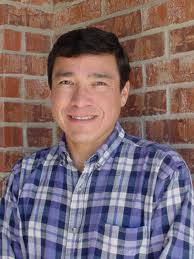
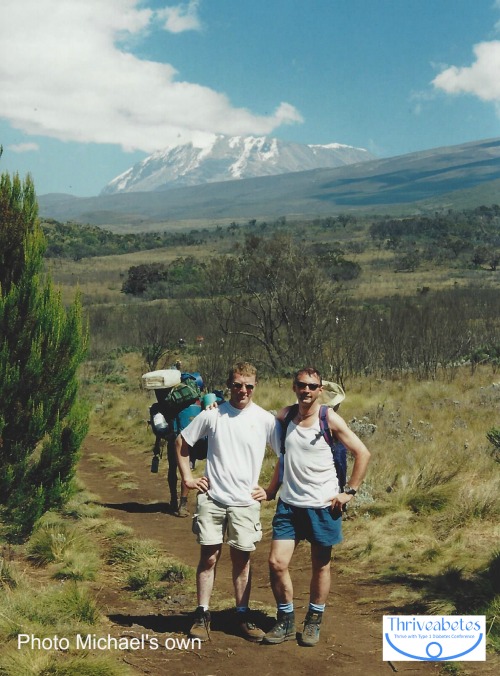
This weeks blog post is from Michael Murphy from Ennis, Co. Clare. Michael has lived with type 1 diabetes for 20 years and volunteers with the Limerick Diabetes parents group organising family walks and hikes.18 years ago, Michael was asked if he would be interested in joining a Diabetes Ireland fundraising climb to Mount Kilimanjaro in Africa. An avid outdoor enthusiast he jumped at the chance to be part of the 36 person team.
"Mount Kilimanjaro is the highest mountain in Tanzania, Africa. It rises approximately 4,900 m (16,000 ft) from its base to 5,895 metres (19,341 ft) above sea level. The mountain is part of the Kilimanjaro National Park and is a major climbing destination.
A small study of people attempting to reach the summit of Kilimanjaro in July and August 2005 found that 61% succeeded and 77% experienced acute mountain sickness (AMS).[59] Kilimanjaro's summit is well above the altitude at which life-threatening high altitude pulmonary edema (HAPE) or high altitude cerebral edema (HACE), the most severe forms of AMS, can occur.[61]" Source; https://en.wikipedia.org/wiki/Mount_Kilimanjaro
 Kili
Kili
By Michael Murphy
‘Thirty-six people, sixteen of whom are insulin dependent diabetics, will be travelling to Tanzania with the diabetes federation of Ireland on Saturday 18 September to climb Kilimanjaro, the highest mountain in Africa, in the shortest recommended time of 5 days.’ said the Clare Champion all the way back in 1999.
It was a thing of dreams for me having grown up with ‘Out Of Africa’ and the beautiful Meryl Streep and the TV program ‘Born Free’ and places in deepest Africa were only seen on the telly and read in books. Nobody I knew had been further than Morocco and that was a stretch of the imagination and when Nurse Nicola from the Mater rang me and asked if I’d be interested in going I took in the region of 5 milliseconds to decide.
Diagnosis (of type 1 diabetes) for me came in the form of four separate doctor’s failing to spot the symptoms that I presented with in the months preceding my eventual diagnosis until I eventually had become virtual catatonic and got carted to the ICU in Ennis General where I remained for a few days until I was stable enough to be moved to the wards. Thankfully no damage was done to me by the delayed diagnosis and once the trauma of the new world of blood sugars began to settle with me, my old life started to recover its ground. I had missed a concert with Lou Reed in Leisureland in Galway and the charity cycle the ‘Clare 250’ mile, but I was determined nothing would prevent me from living my life as I wanted, both good and bad!
The next year saw me prepped and ready for the Clare 250 with many training miles covered. Lucozade by the gallon was consumed and bloods had being regulated to suit the challenge. That particular cycle saw me recover my life. Confidence streamed into me as I felt the strength back in me and it started to cure the mental strains of the previous years as the miles went by. The cycle went off without a hassle and I crossed the line in the final sprint in first, the Clonlara mountain stage in third and finished the most smiley faced on the road. As a result of the Clare 250 records, the call came for the Kili challenge from Nurse Nicola. The mountains were calling. Hunting and fishing would have brought me to the wild places but just the valleys, never the high ground and peaks. The mountains were always a distraction but that has all changed since and the perspective of the world that you get when on the high ground has altered how I view the world and the people in it.
We did a few training and team bonding days around the country including Lugnaquilla, which I especially enjoyed and remember because of a spectacular slip and splash down in front of literally everybody. Everybody was laughing, I can still hear Kieran the fecker! I also managed to get lost on the way home which turned into an ordeal but managed to find myself again and ended up in the north side (of Dublin) at Kieran’s hospitality sleeping in the sitting room with a few of the lads before the early morning flight to Schipol and on to Kilimanjaro International Airport a few weeks later. The airport was great craic with the excitement and drama of it all. One passport had been lost and tears were had while the group formed and checked in and eventually we found ourselves looking out the windows at the mountain in the clouds. It was a stunning view coupled with stepping out of a plane into African heat and light, a motley bunch, which in truth had no idea of what lay ahead.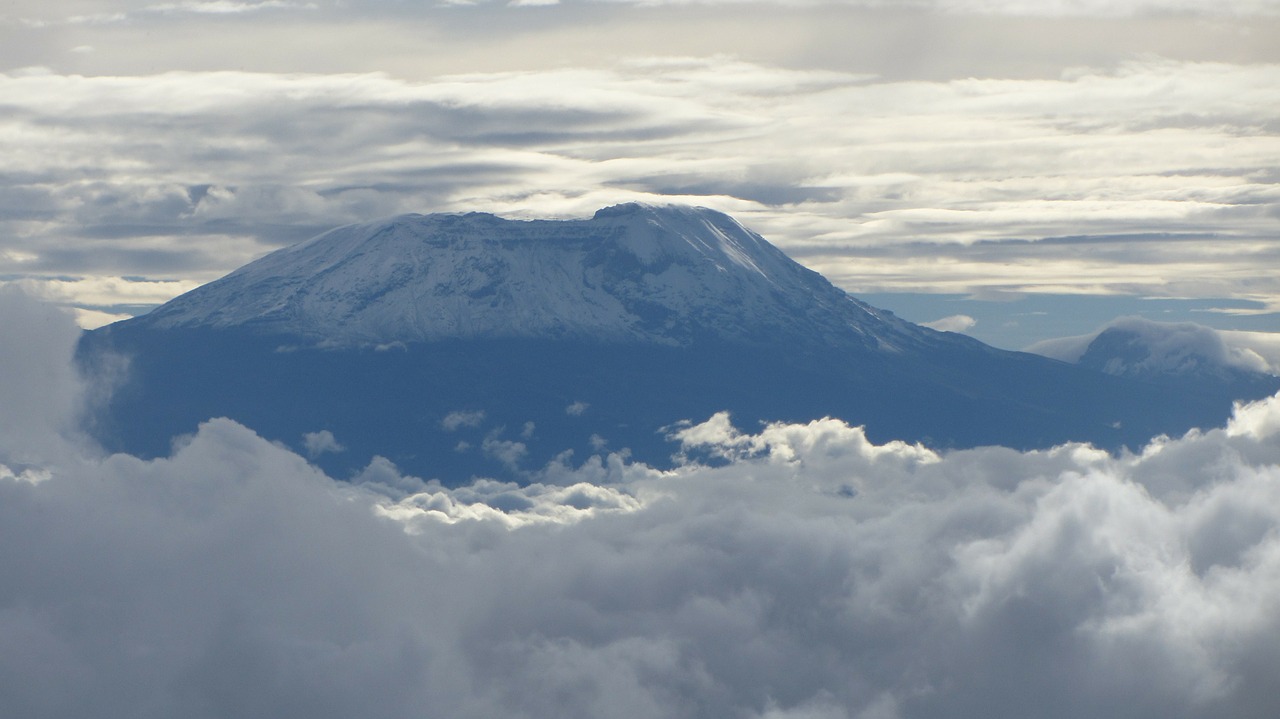
Friendships had been formed with Ivan Allison from Mayo and the comedy team of Gerry and Tony from Dublin. Gerry and Tony had a captive audience and for most of the trip they worked it for all the laughs they could get. Gerry had an endless supply of quips and jokes and didn’t miss a trick on the way. I ended up rooming with this crew in shifts one of whom kept all threat of lion attacks away by snoring the whole night through every night til breakfast. You know who you are Gerry!
Our first African night was in the Lutheran Hotel in Moshi. It was a basic place to stay. It had small lizards everywhere I recall. It was a compound for our security but myself and Ivan escaped the security for a ramble for a beer in Moshi where we had a good laugh in a small grocery/bar something onto old Irish style. I said ‘Cheers’ to the owner and he replied ‘Slainte!’. Not the first Irish there I guess.
We moved on to the Capricorn Hotel that day and eventually to the Marangu gates and the starting point of our climb, 1970m above sea level. 5895m being our goal and the first day was a leisurely climb through the rain forest of lower Kili which was inhabited by Colobus monkeys. There has never been a louder wildlife outside of a Munster match. The roaring went on all day and night and was a real taste of Africa despite the fact that it put the terrors in me that night after getting up to go to the jacks and listening to the cacophony drowning out Gerry.
The route involved three sleeping areas in the Mandara Huts (2715m), Horombo Huts (for some at 3705m) and School Hut (5000m). The distance to Mandara huts was not excessive even though the night terrors could have been symptomatic of the first signs of altitude but everybody was feeling good and the chats were excellent amongst the group. Pre breakfast myself and Ivan did the short hike to Maundi crater and took in the sight of Uhuru peak for the first time. It is something that you never forget the sight of.
After breakfast we set off for Horombo Huts and were on orders to go as slow as possible to take the maximum time acclimatisation. We were on the shortest route up the mountain and the slower the progress the better. I took 10 hours at a leisurely pace and moved forward and back chatting to people before joining the tail group and our guide who entertained us with stories of the area and gave us a few words of the language. He led us in, in full voice roaring ‘Jambo Horombo!!!’ to announce our arrival. It was great to get there after a day of looking west to the Ngorongoro Crater and the Serengeti beyond with Kili ahead of us and Mawenzi to the east. Again these are not sights to forget though the best was yet to come.
I don’t recall exactly but I think we took the extra day to acclimatise in Horombo and hiked up to Mawenzi for a look around and prepped for the ordeal ahead. The next morning was met with our youngest member, 15 year old Mark Finnegan, falling to the altitude sickness. He was disappointed but well looked after by Nicola and they returned to Horombo while we went on to the overcrowded Kibo Huts where we were pushed on to the School Huts on the Kenya side of the mountain. The pace had dropped to a virtual standstill walking one step at a time. Oxygen levels were very low and it was starting to take its effect on people to different degrees. I recall picking up the pace at one stage when I was feeling good and after 15 steps I near capsized with a headache and lightheadedness. It made me very aware that I was standing above airplane cruising altitude and there were dangers in it. The prospect of damage to the eyes especially became very real. I’m generally not afraid of too much but I just have one good eye and the weighing scales of achievement versus consequence started registering. You don’t imagine the reality of these places until you are in them and Kili takes its toll on many people every year.
School Hut was an absolute delight for me! It still gets me nearly 20 years on that I got to sit and watch the shadow of Kili stretch out across the Masai Mara. It is the greatest thing I have ever seen. Off in the distance you could make out the Ngong Hills of ‘Out of Africa fame. Underneath us you had the hunting grounds of Hemingway. All around us was Livingstone’s adventure and not too far away Vasco De Gama’s route around the world. I have stood and looked down on this world of history and stories. For me, this was bliss.
But back to the story at hand, we ate and slept that night packed in like sardines but warm and comfortable until approx 4am when breakfast was served. Two people had the effects of the altitude and had to remain. I was feeling good enough to go further but decided against. The balancing act fell on safety so I sat and watched the crew leave with angst and wondering was I right or wrong not to drive through. I think I was proved right when a few hours later we had a couple more return from the summit push with full altitude sickness. Everybody slept though and the next morning I woke around dawn and took a stroll up the eastern track to about 5,200m. I stared out on the ponderous view ahead of me and was happy that I had seen more than I ever expected in life. It was a good feeling and I didn’t need the peak.
When I came back to the hut one of the lads was in poor condition and getting him back to Kibo and the medical team was an ordeal. I was never as grateful as when I saw Doc Kevin there. He was hurting as well but took over the looking after of the ill as they came down either from the summit success or not. Half of the group to the summit but for some it was tainted by three people having to be wheeled down the mountain on bicycle stretchers at pace and on to hospital where luckily all lived. I believe it was touch and go and huge credit is due to Doc Chris Thompson and the medical team in Arusha for preventing disaster. Chris had oedema himself and pushed through it to ensure safety of the injured.
In that wonderful way of Africa despite the hardship of the hospitalisation and illnesses love blossomed. Maura and Tony went on to have a family about four strong I think and no last effects other than the babies have occurred.
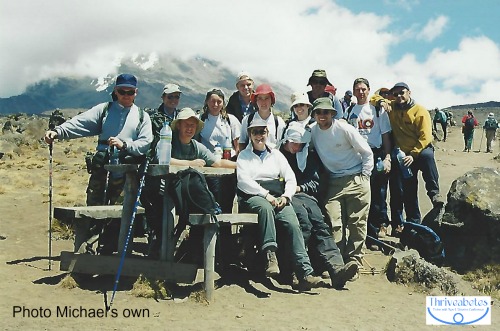 Kili was done and Gerry entertained us without his wingman that night in Horombo Huts and we drank all the beers before a German team came in and gave out that there was no beer for them. The walk out was a long one but all downhill and satisfying in its own way. Exhaustion took me that night and I snored my way through the night as everybody partied and celebrated the success of the trip.
Our strongest on the mountain was Michael O’Dea from Dundalk as I recall. He had type 1 diabetes. The group that made the top were approx 50/50 diabetes/non-diabetes. The altitude caught out about 50/50 diabetes/non-diabetes and the marriage that occurred is exactly 50/50. I remain friends with many from the group and have great admiration for the courage of Kieran and the medical team of Nicola, Kevin, Chris and Randal Hayes for taking risks and winning.
Kili was done and Gerry entertained us without his wingman that night in Horombo Huts and we drank all the beers before a German team came in and gave out that there was no beer for them. The walk out was a long one but all downhill and satisfying in its own way. Exhaustion took me that night and I snored my way through the night as everybody partied and celebrated the success of the trip.
Our strongest on the mountain was Michael O’Dea from Dundalk as I recall. He had type 1 diabetes. The group that made the top were approx 50/50 diabetes/non-diabetes. The altitude caught out about 50/50 diabetes/non-diabetes and the marriage that occurred is exactly 50/50. I remain friends with many from the group and have great admiration for the courage of Kieran and the medical team of Nicola, Kevin, Chris and Randal Hayes for taking risks and winning.
Personally, I have gone on to climb many mountains including Grossvenidegar (Austria), Galdhopiggen (Norway), Havannadalshnukur (Iceland), most of Ireland’s hills and many many more. For diabetes there is no better gym than the hills and mountains both mentally and physically. The clear out of glucose that seems to occur and the increase in the metabolism are great for the body and brain and, besides that, they are a joy to me and all because Nicola Vissard rang and asked ‘Are you interested in climbing Kilimanjaro?’.
Diabetes Ireland were the very first diabetes related national charity in the world to bring a group of people with diabetes to the summit of Kilimanjaro in 1999.
They repeated this expedition in 2016 to much success from both a fundraising point of view and the number of people reaching the summit. 20 out of 21, including 6 with Type 1 Diabetes and 1 with Type 2 Diabetes all reached the summit… an incredible achievement by the group. There is a detailed write up of 2016 here and plan a 2017 expedition also - more details here.

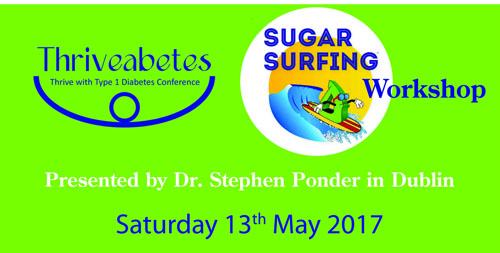 What: Thriveabetes Sugar Surfing Workshop
When: Saturday, May 13th from 10am until 2pm
Where:
What: Thriveabetes Sugar Surfing Workshop
When: Saturday, May 13th from 10am until 2pm
Where: